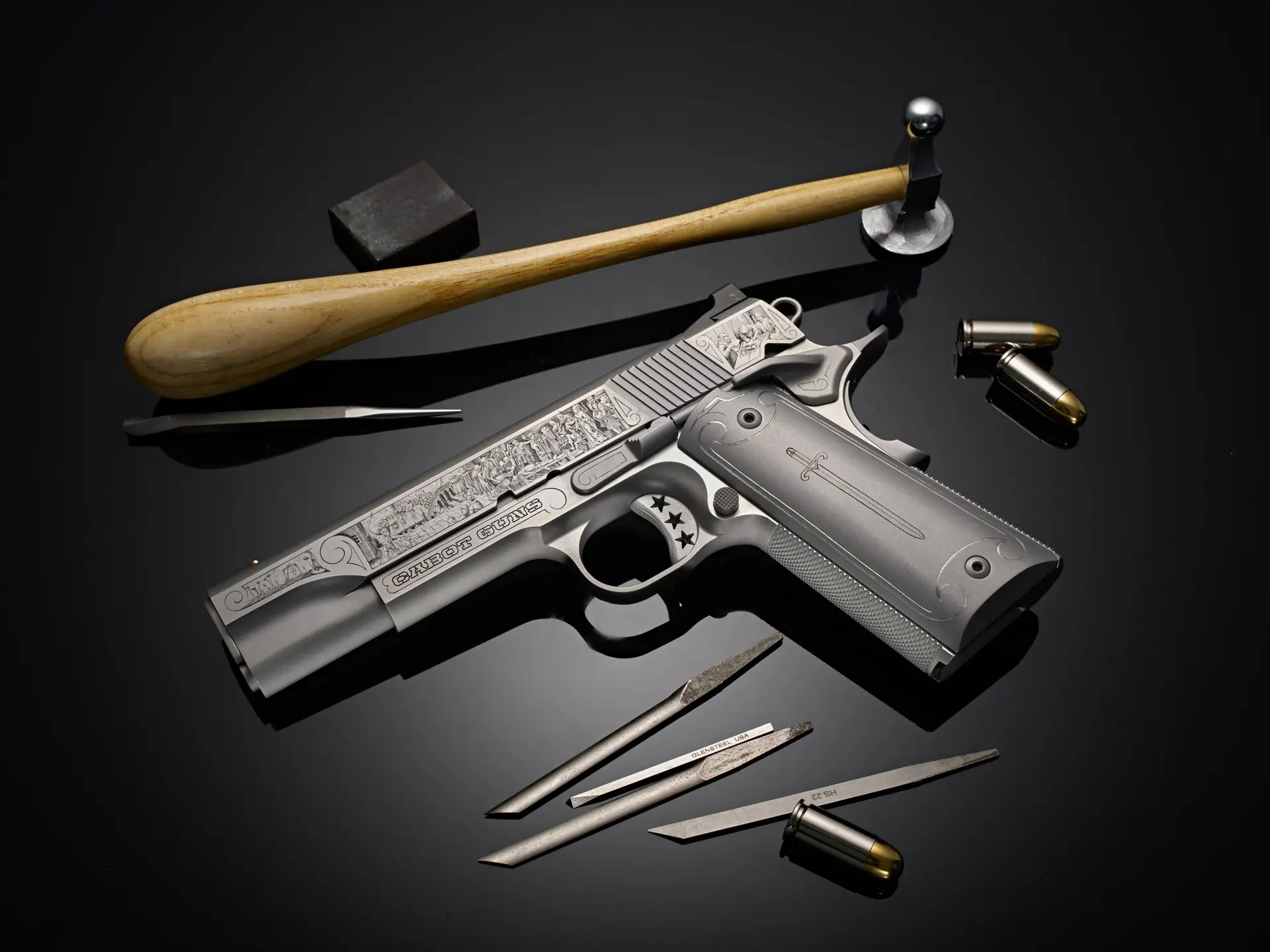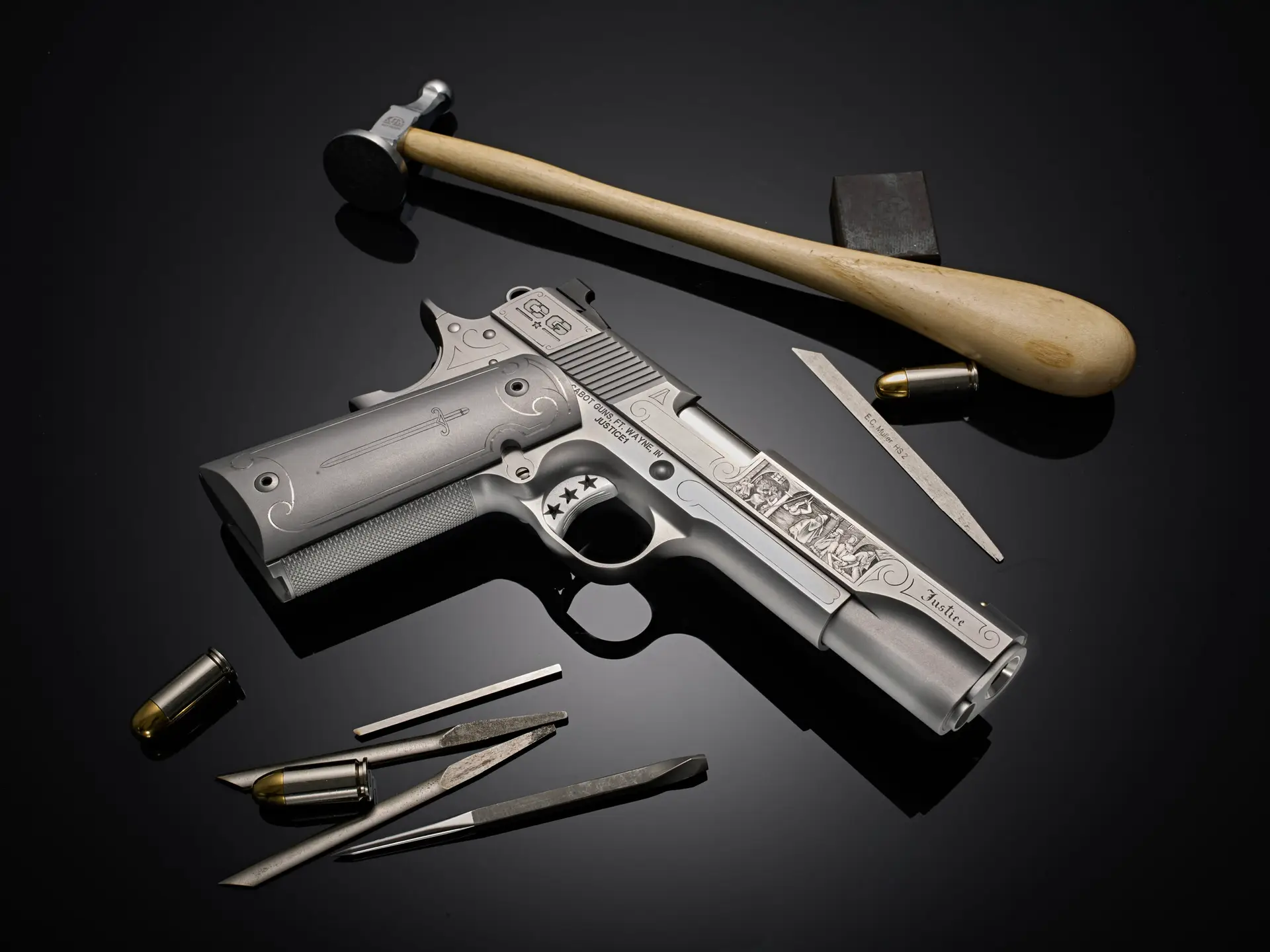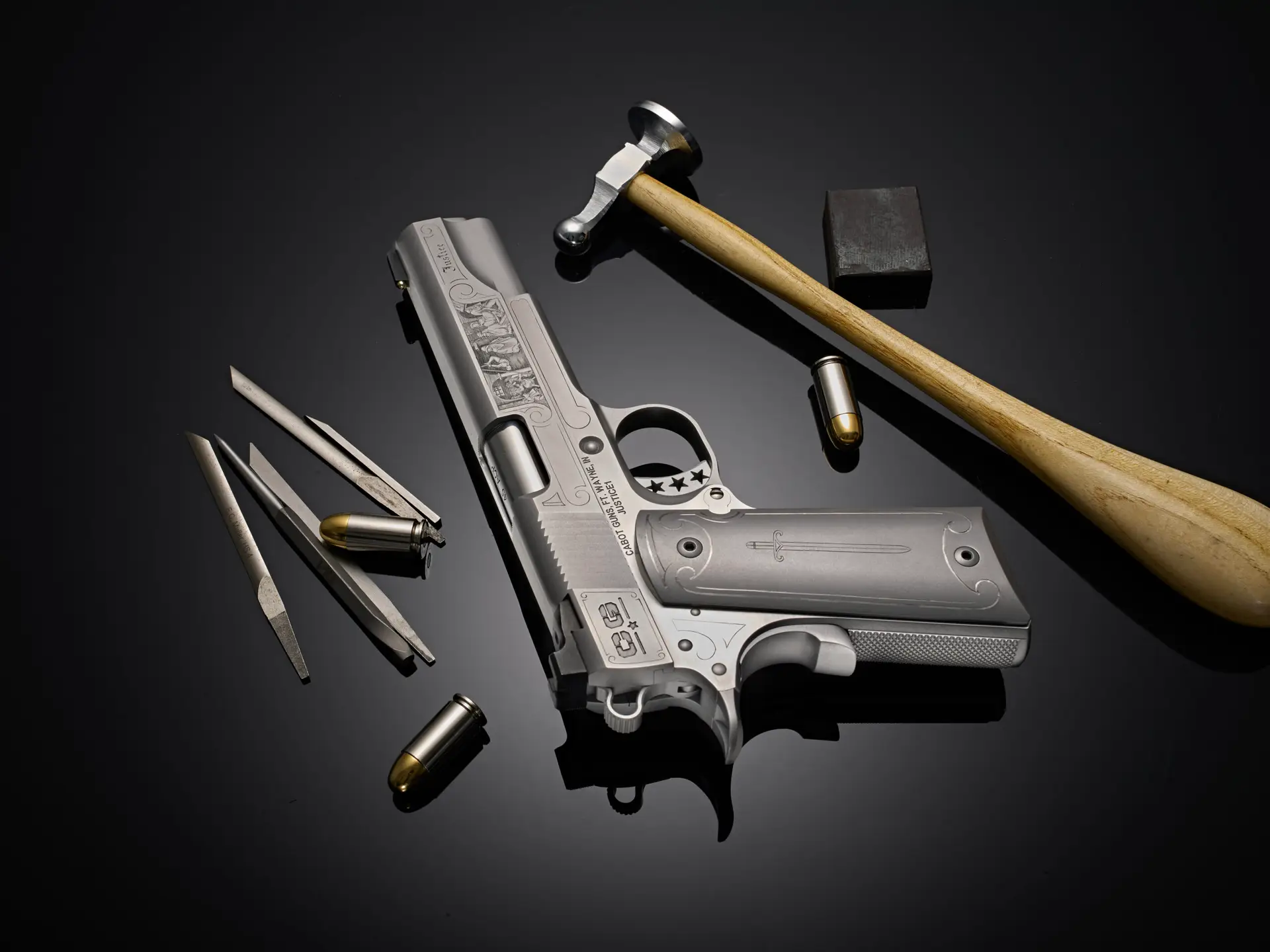
Justice forms the second exalted entry in Cabot Guns’ Seven Virtues Series—a strictly limited edition of just seven pistols, each destined to become a collector’s heirloom of unparalleled artistry. Hand-engraved in its entirety by FEGA Master Engraver Lee Griffiths, this 1911 draws profound inspiration from Pieter Bruegel the Elder’s 16th-century allegorical masterpiece on the Virtues, capturing justice as the unshakeable foundation of a free and ordered society. Bruegel’s intricate vision of law, accountability, moral balance, and the consequences of human action is here translated into steel with extraordinary fidelity—precision American craftsmanship at its most exalted.
The engraving portrays justice not as blind vengeance, but as measured authority rightly applied: impartial judgment weighed on scales, enforced by the sword, and administered through deliberate, restrained process. Rooted in the timeless Latin maxim Iustitia fundamentum regnorum—“Justice is the foundation of nations”—this pistol unites fine art, classical virtue, and enduring legacy in an exclusive creation that transcends the firearm to become a tangible monument to moral clarity and ordered liberty.
At the far left of the slide the scene opens in solemn gravity. A bearded executioner stands firm upon the paved balcony, feet planted wide in authoritative stance, his gaze lifted upward in quiet invocation or ritual pause. One hand grips the broad sword raised high, poised for the clean, decisive downward stroke. Directly before him the condemned man kneels, head bowed in acceptance. In his clasped hands he clutches a small cross, a final plea for mercy beneath the weight of judgment.
To the rear a parallel scene unfolds on a raised wooden platform: another prisoner, bound to a stake, arches backward in agony as an executioner delivers vigorous lashes with a bundle of switches. A dense crowd of guards with pikes and townsfolk in period tunics presses close, caught between morbid curiosity and solemn communal witness. Nearby, an ominous rope hangs slack from the gallows beams, quietly foreshadowing further consequences revealed along the opposite side of the pistol.
The intensity deepens towards the central vignette into a harrowing tableau of interrogation and torment. Upon a wooden rack lies a nearly nude prisoner, clad only in a loincloth, body stretched taut and elongated by the cruel mechanism’s extension. At his feet a bent figure turns the crank of a medieval stretcher with deliberate, incremental force, straining joints and sinews to the breaking point. At his head, two tormentors conduct the infamous “water cure”—a funnel forced into the mouth while liquid pours steadily from a large jug—inducing suffocation and distension in a historical precursor to modern waterboarding, designed to compel confession. Amid such duress, admission appears inevitable.
In exquisite miniature detail captured by Master Engraver Lee Griffiths, to the left of this agony a friar holds open a breviary or record book while a nearby scribe sets down the emerging confession. Onlookers press close: one raises a torch aloft, another grips a bucket of uncertain purpose—water for further torment, a means of revival, or a vessel for suffering’s refuse. Two figures converse yet remain detached while others turn their backs, eyes averted in discomfort or indifference—subtle human responses layered into the public theater of justice.
At the right Griffiths depicts Lady Justice as the commanding allegorical figure of the composition. Rendered in this Bruegel-inspired style and without blindfold, she stands elevated in dignified robes that fall in classical folds. Her right hand holds aloft the perfectly balanced scales, emblem of evidence carefully weighed; her left grasps the sword of retribution. Her expression remains serene, almost impassive—posture upright and composed amid the surrounding tumult. This aloof dignity embodies Bruegel’s characteristic irony: Justice, equitable in principle, presides unflinchingly over the merciless machinery of punishment she authorizes, revealing the profound paradox at the virtue’s core.
Framed by graceful swirling scrollwork at the slide’s muzzle, a delicate elongated vignette depicts a distant execution ground beyond the city walls. The hazy silhouette of the fortified town fades into the horizon across a bleak, barren landscape. Two figures hang motionless from a tall wooden gallows—ropes taut, limbs slack, heads lolled in death—with a ladder still leaning against the structure, evidence of the executioner’s recent labor. Under magnification, sparse debris resolves into a tiny crowd of miniature onlookers, astonishing in precision and scale. Nearby, broken bodies bound to cartwheels are hoisted atop tall poles—a grim punishment reserved for grave offenses such as murder, treason, or heresy—serving as both final execution and long-lasting public deterrent through humiliation and decay. Masterful shadows deepen the scene: heavy cross-hatching darkens beams and forms, while long cast shadows stretch across barren ground, conjuring oppressive light and eerie isolation. To the right, a thick plume of smoke billows in swirling lines, hinting at a lingering pyre or stake-burning just beyond the frame.
In serene counterpoint, a finely framed vignette shows officials and clerks conducting judicial business with characteristic bureaucratic calm. Within elegant scrollwork borders, three robed figures occupy a simple interior: A scribe leans over a book, quill in hand, a bearded figure reads a scroll and yet another sits to the side, glancing away. Note also the extraordinary miniature detail, right down to the inkwell on the desk—a refinement requiring almost magnification to fully realize.
Their stern concentration and impassive diligence convey quiet indifference to suffering. Griffiths’ burin work of parallel and cross-hatching sculpts lifelike weight and drape in woolen robes; subtle lines capture nuance in eyes, brows, and beards; table grain, page texture, and paneled walls gain convincing depth through directional shading.
The scene unfolds through vaulted chambers evoking a medieval judicial dungeon. At left, a convicted thief faces a chopping block as an executioner prepares to sever his hand under the era’s brutal penal code, while observers watch from the shadows.
The narrative continues with a prisoner suspended by bound wrists in the strappado as officials observe the sanctioned interrogation. At right, a clerk records testimony or judgment in a large ledger while another official carries a document into an adjoining chamber. Together, these scenes depict crime, interrogation, punishment, and record-keeping in extraordinarily fine Northern Renaissance–style engraving, faithfully adapting Bruegel’s allegorical depiction of Justice.
The stainless steel grips, yet another component masterfully crafted by our Master Machinist and flawlessly tailored to the frame, bear hand-engraved borders in classical ornamental scrollwork echoing Renaissance and Baroque architectural carving. A continuous recessed line frames each panel, with elegant volutes—spiraling scrolls—terminating symmetrically at top and bottom, imparting balanced movement within disciplined geometry. At the center of each grip the Sword of Justice is engraved downward in vigilant readiness: symbol of authority’s power to act once truth is weighed. Modeled from the Sword of Justice that crowns the flagpole before the U.S. Department of Justice building in Washington, D.C., it represents the measured strength of justice—protecting the innocent, confronting wrongdoing, and upholding order with steady resolve.
Throughout, Lee Griffiths’ mastery is transcendent. Burin work imparts remarkable three-dimensionality: heavy robe and tunic folds ripple with lifelike texture via precise hatching; faces convey profound psychology—the executioner’s solemn upward gaze, the condemned’s resigned supplication with cross in hand, Justice’s serene detachment, onlookers’ spectrum of curiosity, horror, and indifference—all through the subtlest modulation of line. Wooden elements—scaffolds, racks, pillories, gallows beams—bear authentic grain via directional stippling and parallel cuts. Minute details abound: coiled ropes, delicate chains, balanced scales, honed sword edges, the tiny cross—each rendered with breathtaking clarity.
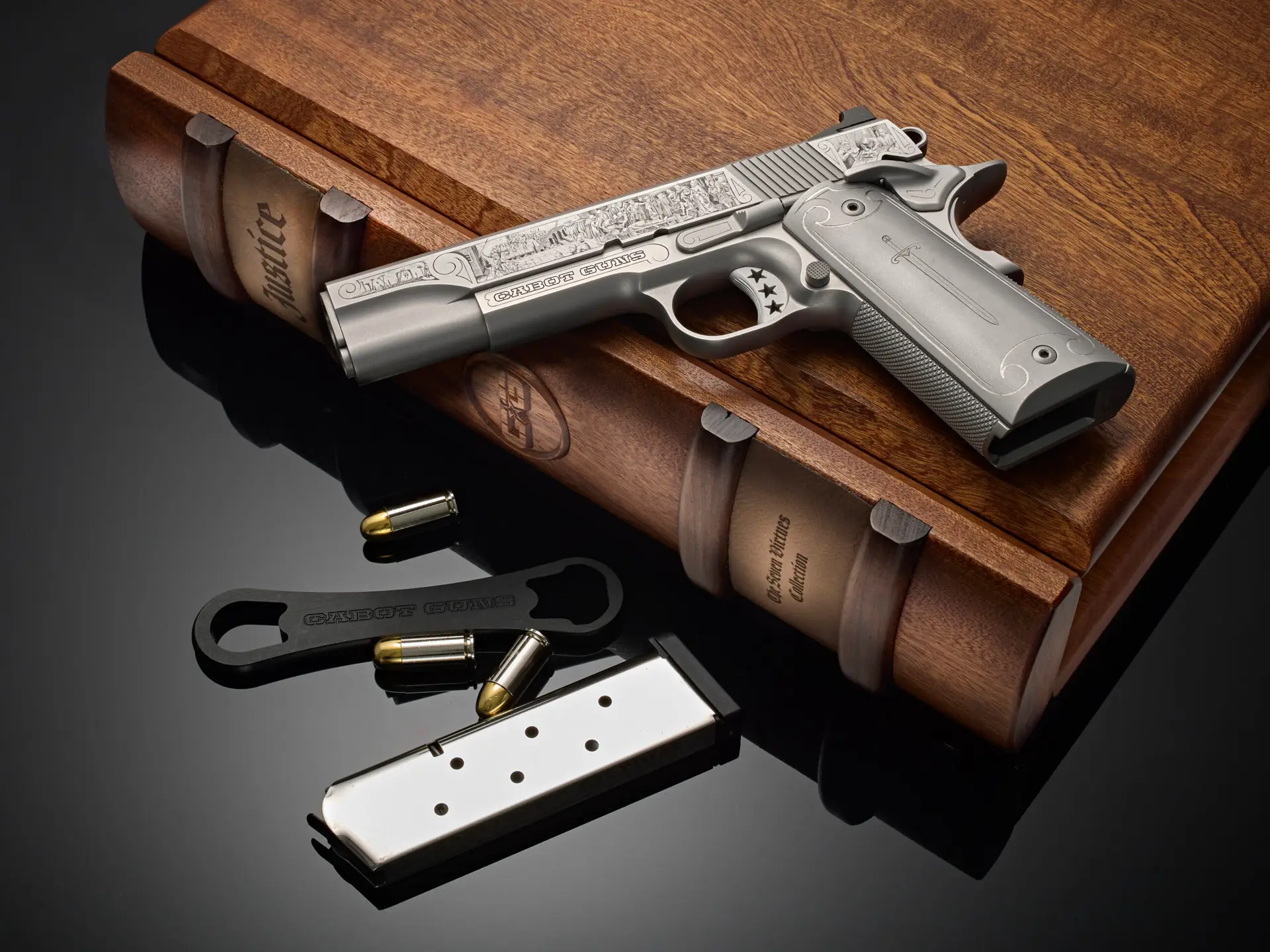
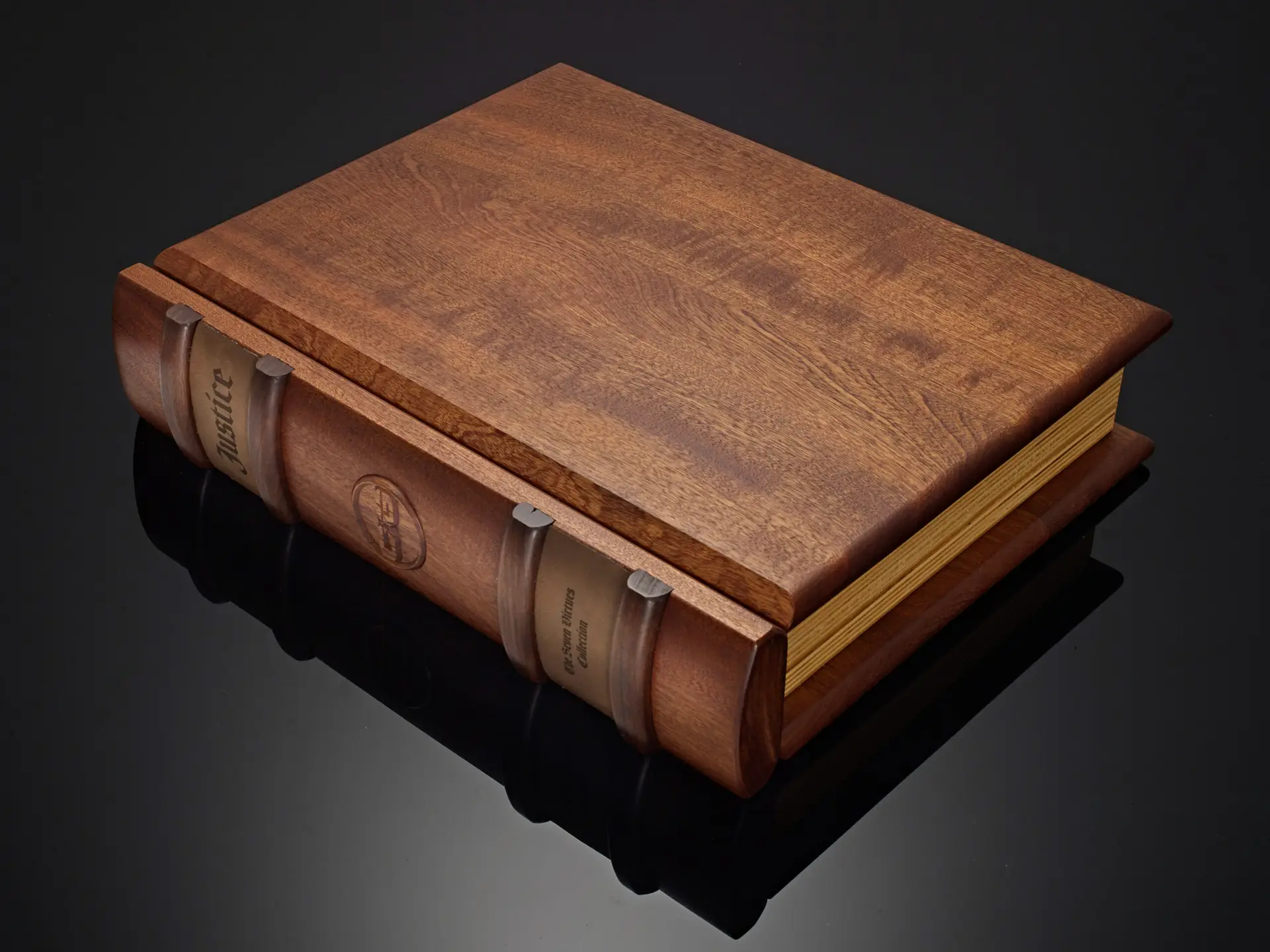
Encasing this treasure is a mahogany bookcase, crafted by master woodworker Mark Huston, a former engineer whose precision shines in every joint. Secure, concealable, or display-ready, it features a Freedom Design fit with a hidden rare-earth magnet. It’s spine is embellished with two leather patches—“Justice” and “The Seven Virtues Collection”—for a touch of elegance. Stand it upright like a volume on a shelf, and picture all seven cases as a collector’s library. Faith is more than a pistol—it’s a fusion of art, virtue, and engineering excellence, destined to endure.
In its entirety, the pistol presents a complete judicial cycle—judgment weighed on balanced scales, enforced by the sword of retribution, and faithfully archived in precise records—unfolding across the steel with remarkable narrative clarity and emotional depth, recognizing the extraordinary detail achieved within the intimate miniature scale of the engraving. This full-size Government 1911, chambered in .45 ACP and built entirely from premium 100% American stainless steel for enduring strength, corrosion resistance, and timeless luster, is hand-crafted by Cabot Guns in Butler, Pennsylvania—100% Made in America with the legendary ultra-tight tolerances, flawless hand-fitting, and renowned reliability that define the marque. Each bears a custom serial number from JUSTICE1 through JUSTICE7, ensuring absolute exclusivity within this limited edition of just seven pistols. Justice is far more than a firearm: it is Cabot’s uncompromising expression of precision engineering elevated to fine art, profound historical reverence for Bruegel’s moral allegory, and resolute conviction in the classical ideals of ordered liberty—crafted for discerning stewards who seek not mere ownership, but guardianship of an extraordinary, generation-spanning heirloom.
Justice: A Limited Edition Offering of Seven Pistols
Price: $17,900 each
The Cabot Justice- a Limited edition Cabot 1911. Only 7 Justice 1911s have been produced. These pistols are complete and will be ready for delivery to your FFL within 30 days. 25% deposit due at time of ordering, balance is due in 30 days via ACH or Wire Transfer. If you are the owner of a FAITH pistol, you will automatically be given the same serial number in the 7 Virtues series. Cabot 1911s are not available in CA or MA
Out of stock

Thank you for visiting Cabot Guns. Our overreaching government has made it necessary to ask if you are over 21 years old to view our website. Also, some Europeans want us to tell you we use cookies on our website (all websites do) but we do not share any information with 3rd parties. Check out our Privacy Policy for more info.